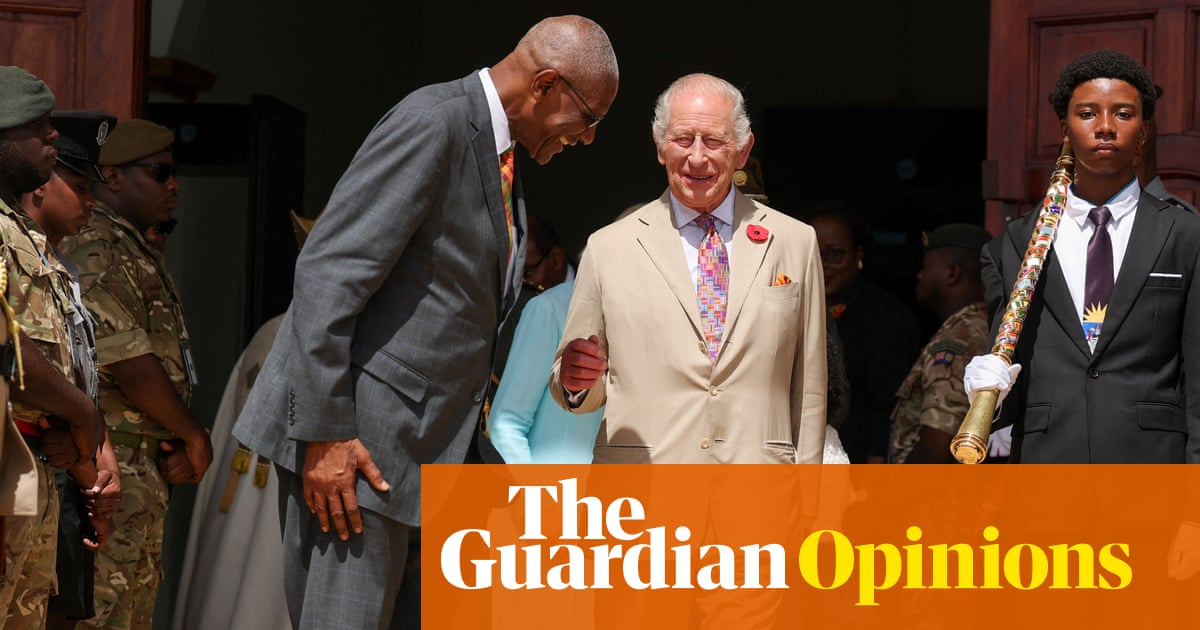
Dear King Charles, You are currently on a Caribbean royal tour through the Bahamas, Guyana, and Antigua and Barbuda. I understand that during this tour you will not issue a formal apology for Britain’s role in the transatlantic slave trade, or address the role your own family played in it. You will instead express your “sorrow”, and this will make it easier for politicians to also dodge the question.
Whether that is Kemi Badenoch calling an apology a “navel-gazing distraction ”, or the prime minister, Andy Burnham, saying he would support an apology, while flatly opposing reparations. Coincidentally, I’m also in the middle of a world tour for the English translation of my book, Jaguarman, a novel about how my enslaved Surinamese ancestors survived 300 years of hell on Earth. I travelled from Ghana to Indonesia to New York, when I was asked to respond to you, as soon as possible.
That’s how it often goes in this strange story, I’ve noticed: people like you get centuries to find the right words, while we must scramble to respond to your actions. But, yes, I do have something to say. Three years ago your Dutch counterpart, King Willem-Alexander, stood before an audience of people of colour, many of them my friends.
Dressed up like kings and queens, they listened solemnly as he did what you will not and apologised for the role of the Dutch state in enslaving our ancestors , and for the failure of his own family, the house of Orange-Nassau, to act against it. Slavery was “a crime against humanity”, he said, “and the stadholders and kings of the house of Orange-Nassau did nothing to stop it”. It was a moment that people on whose shoulders I stand had fought for for centuries, often at the risk of their health or even their lives.
Willem-Alexander’s speech was directed at people of colour such as me. But I felt that the apology was perhaps even more important for the rest of the population. It happened in 2023, on 1 July, the day the Netherlands commemorates the abolition of slavery, a celebration called Keti Koti.
In the Netherlands, many institutions tend only to invite writers such as me to speak on this one particular day, so as Willem-Alexander was addressing the nation, I was somewhere else, in a small library, in front of an audience of mostly white people, giving my own lecture about what they could learn from my Black ancestors. We from the colonial diaspora already know the true history of our mother country. We already know what the powers that govern us are capable of.
We know the darkness they can create. And we also know that it is possible to come through that darkness. To me, the apology was most important for all these other people who thought my history had nothing to do with them.
For those who had never considered that there might be something to learn from the people who gave me this life. skip past newsletter promotion after newsletter promotion You know the truth, Willem-Alexander knows it, I know it, but many of your subjects do not. The truth is my ancestors were kidnapped. Chained.
Trafficked across the ocean. Sold. Torn from one another.
Turned into property. Brainwashed. Silenced.
Mocked. Cursed. But the fire inside us was never extinguished.
Despite the plantations. Despite the Atlantic. Despite the slave forts.
That is why I am alive. That is not a small thing. It is enormous.
That’s why the people receiving Willem-Alexander’s apology were dressed up like kings and queens. They know what a huge gift it is to be alive, and how important it is to take care of what you have been given. They know that they have not been put on this earth in order to wither.
They have been put on this earth to blossom. And even if all your freedom is taken away from you by other people, you can find ways to flourish, because the spark of life itself is on our side. Its fire will keep burning, your majesty, whether you apologise or not.
The true heroes in this history were rarely born as royalty. But, of course, being born as royalty doesn’t prevent you from doing the right thing. You cannot stop the truth from coming out.
But you can choose whether history remembers you as someone who stood in its way, or someone who stood with it. Raoul de Jong is a Dutch novelist
Source: The Guardian